
By Anna Verhoeve (ILVO), co-author of MOSAIC’s Policy Lab Guidelines
The European Green Deal, the EU Biodiversity Strategy for 2030, and the Farm to Fork Strategy all aim to transform the way land in Europe is managed and address the climate and nature crises. To meet this ambition, Europe needs practical policies that are grounded in science and co-created with local stakeholders.
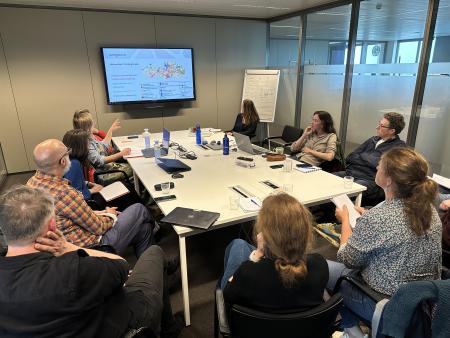
In the MOSAIC project, we’ve developed a Policy Labs approach in Belgium, Denmark, Hungary, Portugal, Switzerland, and the entire EU. In each Policy Lab, scientists, policymakers, and local stakeholders come together to co-create actionable knowledge and test land-use policies. These six Policy Labs have now all been established and are actively exploring policies on water scarcity, voluntary carbon markets, the trade-offs between protecting biodiversity and generating renewable energy, improving the quality of grasslands, and more.
In our new publication, Practical Guide for Policy Lab Initiators to Set Up a Policy Lab, my colleagues and I have brought together our insights from setting up these six policy labs and we also share six practical steps that other policy makers or researchers can take to set up their own Policy Labs. The novelty of this guideline primarily lies in its systematic, operational and practical step-by-step approach to establishing a policy lab to co-design policy innovation on land use governance. It transforms broader theoretical concepts and dispersed information into actionable, hands-on guidelines, incorporating specific methodologies and considerations. The integration of concrete examples from the MOSAIC project also contributes to its practical relevance.
Six building blocks for a successful Policy Lab
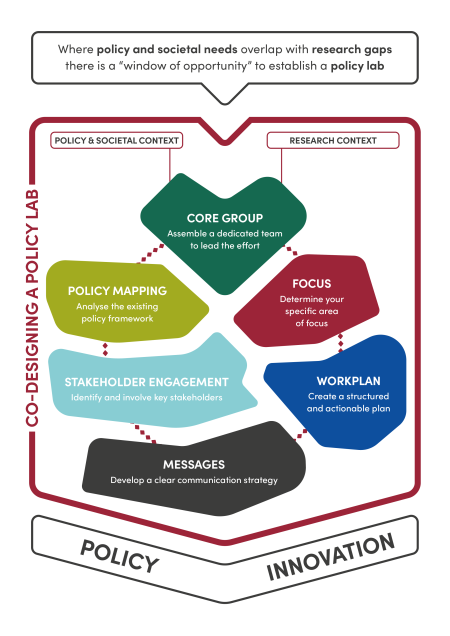
1. The Core Group
The core group is the Policy Lab’s central steering body. At the core of every Policy Lab there are two indispensable roles:
- Knowledge Broker: usually a researcher who deeply understands the research context related to the policy lab's challenges. Their tasks include co-designing the lab, ensuring the integration of scientific and experiential knowledge, facilitating knowledge exchange, planning activities, collecting feedback, and reporting on lab activities.
- Policy Lead: someone inside policymaking who is actively involved in policy development. Their responsibilities include co-designing the lab with the knowledge broker, delivering context-specific knowledge and social networks, acting as a point of contact for local stakeholders, providing practical feedback to research, connecting with ongoing policy discussions, and facilitating stakeholder engagement.
Together this pair forms the operational core of the Policy Lab, cultivating a cross-disciplinary, collaborative network. To establish a successful core group, the Knowledge broker and Policy Lead must build trust, identify the right people, balance policy and research priorities and manage participant workloads.
2. Common Core Focus
Each Policy Lab needs a clearly defined policy challenge or “window of opportunity” aligned with societal needs and research gaps. This is about finding alignment between policy momentum, societal urgency, and research capability.
For instance, in Switzerland, new mandates for spatial planning of solar farms opened a window to facilitate dialogue on land use trade-offs. In Hungary, recurring droughts in the Sand Ridge region became a catalyst for rethinking land and water management.
These moments can be fleeting, so Labs need to act quickly but thoughtfully, identifying opportunities and starting conversations early.
3. Policy Mapping
Policy Mapping is about understanding the rules of the game. We use tools like policy cycle analysis and institutional mapping to clarify where and how interventions can be effective.
For instance, in Portugal, we mapped policies across governance levels to spot entry points for co-creation. In Denmark, institutional analysis revealed systemic barriers to peatland restoration and how they link to climate and biodiversity goals.
4. Stakeholder Management
Inclusive stakeholder engagement gives the Policy Lab legitimacy and ensures policies are not just technically sound, but also socially fair but also socially grounded and just.
Our approach deliberately involves unconventional stakeholders — those who are often left out of formal processes, such as small farmers, youth groups, or marginalized communities. In Hungary, for example, we directly reached out to likely skeptical stakeholders. Through a series of interviews with initially skeptical people, we better understood different views on how water scarcity could be addressed through changing subsidies, ultimately leading to better policy proposals.
5. Coherent Workplan
A clear, flexible workplan keeps everyone aligned on goals, methods, and timelines without stifling creativity. We’ve found “timeline workshops” are a great way to co-develop these plans together.
6. Main Message
Finally, a compelling communication strategy is needed to ensure our Policy Lab members and the people we work with understand what we are doing and why it matters. Communication is not an afterthought, it is a strategic tool that is essential for achieving our Policy Lab aims.
Next steps
If we want to meet the targets of the Green Deal, restore nature, and create more resilient food and land systems, we need new ways of making policy. Policy Labs are a promising way forward and I’m excited to see how others use a Policy Lab approach to co-create better land use policies for a more sustainable Europe.
If you’re a policymaker, researcher, NGO, funding body, or anybody committed to building sustainable land use policies, our Policy Labs guide is for you.
Download the full guide and follow MOSAIC to find out more about our Policy Lab work.