

The Aarhus municipality in Denmark invests about 600.000 € per year on afforestation projects on former agricultural land to provide much needed recreational areas for a growing population in the second largest city in Denmark. This serves to protect the drinking water resource and surface water quality, and to sequester carbon and improve biodiversity over time. The afforestation projects are funded using different business models in collaboration with private companies, NGOs, State Forest Agency, the water utility company and national funds, which the municipality aims to develop further.
Below, you will find three examples of how the Invest4Nature Living Lab Aarhus in Denmark organizes and finances afforestation projects and what funding mechanisms they are considering in the future.
- The Hasselager Wild Forest project
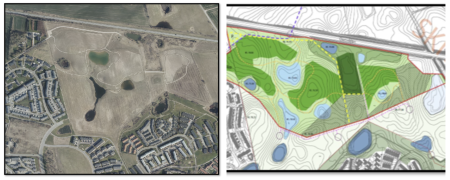
The Hasselager Wild Forest project involves establishing a new forest of 30.000 trees in suburban areas (equalling 15 ha). Instead of people imagining just pathways of trees, the Aarhus municipality frames this afforestation project as “forest landscapes”with streams, lakes, meadows, and open spaces within the forest, in addition to pathways of trees.
The project is implemented on municipal land through a collaboration between Aarhus Municipality and the Growing Trees Network (GTN). The GTN collects donations for afforestation projects from private companies. In this specific project, the private company is a furniture production company called Holmris B8.
The business model for funding the Hasselager Wildforest is called a ‘pay-per-tree model’, in which a private company (here Holmris B8) pays 2.45 Euros per tree to GTN, and the GTN transfers 1.94 Euros per tree for the afforestation project. The model has been running successfully for 3-4 years. The pay-per-tree model covers seedling, planting, fencing and maintenance for the first 3 years.
- The Spørring People's Forest
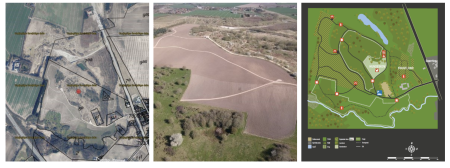
The project entails planting about 24.000 new trees (equaling to 16 hectares) to create a new forest landscape where a water stream connects to surrounding natural areas. The landscape offers recreational areas such as a dog-walking forest, walking paths, cabins, and fruit orchards. The land for afforestation is owned by Aarhus municipality and is financed with funds from a national TV fundraising campaign called “Danmark planter træer” (Denmark plants trees) supported by the television broadcaster TV2 and the Danish Society for Nature Conservation. A national TV2 event, held in 2019, raised funds to plant over 1 million trees nationwide in order to fight the climate crisis. Aarhus Municipality in cooperation with the Growing Trees Network (GTN) allocated funds from the TV-telethon to establish the “Spørring Folkeskov” (Spørring People’s Forest).
- The Ajstrup School Forest project
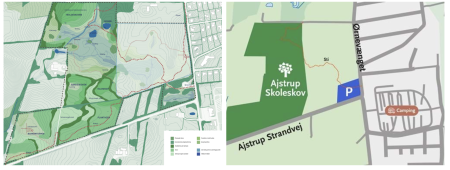
The Ajstrup School Forest project area has been designed and established for and by school children, allowing them to engage and interact with nature (16–20 ha). Schoolchildren from Aarhus Municipality are invited every year to plant trees so that the forest area gradually expands up to a maximum of 20 hectares. Children learn about the processes involved in planting a forest (e.g., CO2 storage, biodiversity) and follow the growth during their school years. In 2022, the first year of the project, 250 school children from 0 to 2nd grades were invited to plant 3000 trees in the Ajstrup School Forest. The theme of the project is “Bushcraft”, where the forest is intended to grow wild with minimum human intervention, hence not requiring maintenance expenses. The project incurs only costs of fencing to prevent deer browsing damage, with fencing to be removed after 5–7 years.
Children are allowed to roam freely around the Ajstrup School Forest, break down seedlings and young trees, make caves, etc. In that way the children act as the natural ‘thinner’ of the seedlings. Moreover, by letting kids plant the trees, the seedlings are not planted in strict lines, as when you afforest mechanically – hence the forest starts to look very different from the very beginning. This project is done in collaboration between the Aarhus municipality and the NGO “Plant et Træ” (Plant a tree), collating and administering funds for tree planting across Denmark, with funds originating from private companies, foundations, municipalities and individuals.
Alternative financing models
The Municipality of Aarhus has reached a level of afforestation that it has run out of municipal land to continue afforestation. It is therefore necessary to include the acquisition of land in the business model to continue the cooperation with e.g., the NGOs GTN and “Plant a Tree”. As a result, the municipality now aims to move from a “pay-per-tree” model to a “landscape” model in which the acquisition of land is covered 25% by the municipality, 25% by the private companies, and 50% covered by the water supply company; the latter keen to secure that no pesticides and fertilizers are applied in vulnerable groundwater areas.