
The agile approach is commonly used in the business world because it focuses on user needs to help ensure end products are fit for purpose. Can we apply this same thinking to improve the outputs of Invest4Nature? How do we add value to Invest4Nature’s products?
Being agile and wanting to co-produce outputs with stakeholders is a great ambition for any project. It means that the end-users of those outputs are involved throughout the process – from identifying the needs and formulating initial ideas; through product development and testing; to making sure the finished outputs are ready to use and fit for purpose. It makes good ‘business sense’ and it’s how the majority of successful companies go about developing their products: by focusing on user needs and being agile throughout the product development process.
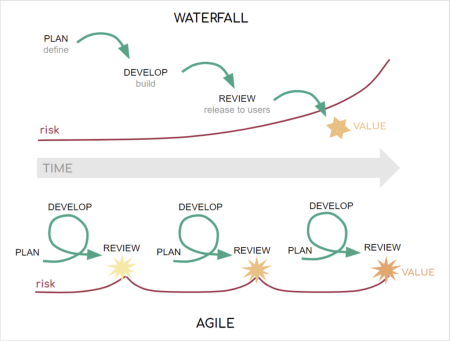
Diagram illustrating the waterfall and agile workflows – Mortelmans, D., Callebaut, J., Salmon, N., and Jacobs, S. (2021) Draft guidance document about the INTERLACE agile workflow implementation and the agile workflow meeting strategy. Interim report. Deliverable 1.1. INTERLACE Project.
‘Agile’ is itself a term that we commonly use in the context of EU Horizon projects, but it’s not always used correctly. We sometimes think of agile as meaning flexible or quick to respond, but in its true sense being agile means breaking a development process into iterative phases; being proactive in pursuing continuous collaboration and improvement; and not being afraid to try another approach if things aren’t going to plan. “Fail fast, fix early” is a commonly used agile mantra. But what tends to happen is that projects “fail slowly and fix too late”. So how can we avoid this pitfall?
At Invest4Nature, we want to be as agile as possible and provide opportunities for stakeholder to not only get involved as consultees but as collaborators, working alongside the project team in designing, developing, testing and ultimately using our project’s outputs. It’s not an easy process; it takes energy and commitment from everyone involved. But now that the project is entering its second phase, with numerous deliverables in the pipeline, we’re going to be seizing opportunities to bring stakeholders onboard as collaborators wherever possible.

Screenshot of Invest4Nature’s Workspace
Some of this momentum will be generated by the stakeholder events programme, commencing rollout in autumn 2024 with a mission to “meet stakeholders where they are” and engage organisations outside the project consortium in two-way knowledge exchange: sharing what we have learned with stakeholders, but importantly learning from them too. We’re going to be supporting this programme with an online workspace, in development as part of the new Oppla platform, through which stakeholders can contact and work with members of the project team on specific tasks and deliverables at their own convenience. A demo version of the workspace is already available, but the new version will offer considerably more functionality and usability beyond this – and we’ll be working with project partners throughout the autumn to get ready for his new toolset, which will be re-launched towards the end of the year. In the meantime, if you’re interested in the agile approach and how it could be applied to your work, then we can recommend the Agile Guidance developed by our friends at the INTERLACE project, which provides advice on applying agile best practice to EU Horizon projects. Available for downloading on Oppla: https://oppla.eu/product/28873
Author: Paul Mahony, General Manager, Oppla
Website: www.oppla.eu
Twitter: @OpplaCommunity
LinkedIn: https://www.linkedin.com/company/oppla