

On August 18th of 2024, the EU Nature Restoration Law came into force with the main objective of recovering ecosystems, habitats and species across EU’s land and sea areas. For the first time ever, the EU sets a legal framework with binding targets not only for nature preservation but also its restoration. It aims to cover 20% of EU’s land and sea areas by 2030, and 100% of all degraded ecosystems by 2050.
The law builds on existing environmental legislation that aims to protect nature, halt biodiversity loss and reverse ecosystem degradation, such as the Biodiversity Strategy for 2030 and the European Green Deal. Moreover, the regulation is expected to bridge synergies with EU climate policies and global commitments.
Currently, 81% of Europe’s habitats are in poor condition, hence the urgency to establish binding restoration targets across different landscapes and ecosystems, including forests, urban, agriculture, and marine. Specific targets encompass improving forest and river connectivity by removing artificial barriers, restoring marine habitats and marine species (e.g., dolphins, sharks, and seabirds), increasing carbon stock in croplands, increasing farmland birds, restoring drained agricultural peatlands, improve urban green spaces, and increase pollinator populations.
The law requires EU Member States to prepare and submit Nature Restoration Plans adapted to their national context. Through these Plans, EU countries are expected to outline the path to deliver on their targets, and subsequently monitor and report on their progress.
The adoption of the law will seemingly develop restoration projects with nature at the core. Consequently, the regulation embodies a relevant policy to further increase the demand for Nature-based Solutions (NBS). This will create new financing opportunities for Nature-Based Enterprises (NBEs), namely organizations delivering goods and services that contribute to ecosystem restoration directly or indirectly. For example, for-profit wetland restoration companies will help meet the targets of the regulation insofar as they can rewet and repair degraded wetlands while recovering bird populations. Other conservation organisations and companies (for-profit and not-for profit) will contribute to reach the regulation targets by implementing NBS projects re-establishing biodiverse habitats and pollinating species. The continued growth of NBS investments will incentivize the emergence of an increasing number of NBEs, thus supporting the transition towards a nature-positive economy that aims for a full recovery of nature by 2050.
NBS cases in the multitude of landscapes being studied within Invest4Nature:
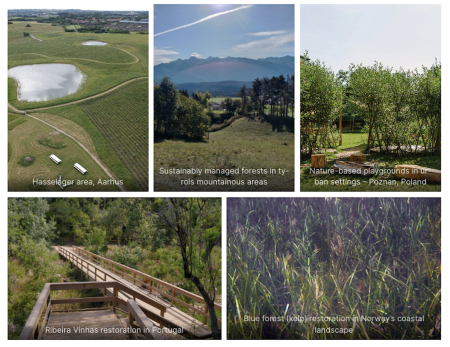
Author: Aarhus University Invest4Nature team
Photo Credits: Invest4Nature Living Labs
Cover picture: Aarhus Municipality