

In the City of Aarhus, we face various man-made challenges that require us to take a stand and initiate actions to meet these challenges. The challenges are related to pollution of groundwater, decline in biodiversity, adaptation to more water in the city, the climate crisis and in general to ensuring that Aarhus remains an attractive and ‘livable’ municipality in the future.
Several of these challenges call for nature-based solutions – both when it comes to challenges in the rural areas, in the outskirts of the city and in the centre of the city. We use nature-based solutions because in many cases they create added value beyond just solving the core challenge. In addition, nature-based solutions can be cheaper – especially when you include the added value they create. The following examples describe how.
Hasselager forest – a new urban forest landscape
One example of an NbS creating added value is afforestation as a tool to prevent pesticide contamination of groundwater. The conventional solution would be to ban the use of pesticides in particularly vulnerable groundwater areas. This would safeguard groundwater from pesticides, but provides no added value.
Hasselager Forest was established precisely to create added value and not only to safeguard groundwater by pesticide-free operation.
Hasselager Vildskov is located as a new forest landscape immediately adjacent to residential areas in Hasselager, a suburb of Aarhus. The forest landscape includes lakes, streams, open nature and forest sections in a slightly hilly landscape and it has contributed to securing groundwater, increased biodiversity, better recreational opportunities, and to CO2 sequestration.
Hasselager is surrounded by access roads, ring roads, motorways and railways. In addition, it is also an area where drinking water is collected for the citizens of Aarhus, and the drinking water well returns a 300-meter zone where no buildings may be built. The area is owned by Aarhus Municipality, and for many years it has been leased solely for pesticide-free farming, with fields that citizens had no access to.
Development of a forest landscape
When we create new municipal forests, the operation is pesticide-free and we focus in particular on the potential for increased biodiversity and – in an urban area like Hasselager – on recreational opportunities. No production from the forest is expected, but it provides benefits such as clean drinking water, increased biodiversity, CO2-sequestration, recreational value, and new communal areas.
New opportunities for citizens
The conversion from farming to forest landscape has opened up the area to local citizens. Where previously there were only crops, there is now a nature area with a path system, tables and benches, a lake to catch insects in, and streams to keep an eye on. In addition, the citizens themselves have established a cattle guild where the animals graze the light-open areas in the forest landscape, which is important to promoting a varied forest landscape. At the same time, it gives local citizens the opportunity to form new communities around the supervision of the cattle and the care of the light-open nature, such as meadows.
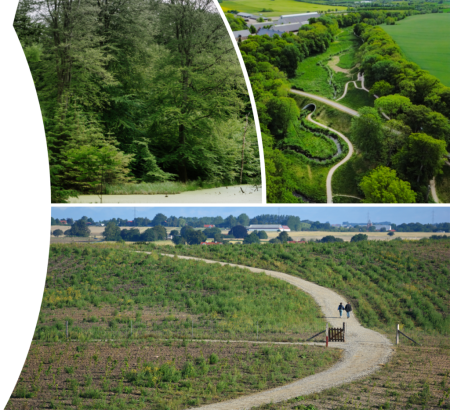
Newly planted forest and older afforestation projects in Aarhus Municipality
Added value
By choosing a nature-based solution to protect drinking water instead of pesticide-free farming, far more municipal goals are achieved, and the citizens of Hasselager experience a great increase in their recreational opportunities, increased property value, opportunity for social communities and a proximity to a nature they would otherwise have to travel by car to visit. If you include these values in the accounts, they greatly outweigh the costs of establishing the forest landscape instead of running pesticide-free farming.
Risvangen – the climate adaption project
Another example of an NbS chosen for its added value is the climate adaption project ‘Risvangen’.
In the district Risvangen in the city of Aarhus, the challenge is the increasing events of cloudbursts that create flooding of basements in the area’s houses, and result in pollution of the bathing water at the beach outlet into the Bay of Aarhus. The main objectives of the project are to separate wastewater and rainwater, and at the same time to adapt the area to climate change.
Traditionally, climate adaption projects involve underground piping, but instead it was decided that in future, the area’s rainwater should be handled on the surface – in gardens and in the public areas. The advantage of above-ground rainwater solutions is that major ‘rain events’ (cloudbursts) can often be handled at the same price as piping, and at the same time, the blue and green nature-based solution adds environmental and recreational value to the area.
This is a joint project between Aarhus Municipality and Aarhus Vand (water utility company), where Aarhus Municipality has contributed with financing of benches, fitness equipment, road bumps, additional trees, etc., while Aarhus Vand has financed the cost of rainwater handling.
Blue and green added value
In Risvangen, rainwater is managed by delaying its flow, allowing it to evaporate or dissipate at a rate suitable for the receiving pipe system. During normal rainfall, rainwater seeps into underground drains located beneath all rain beds and wadis. During heavy rainfall, these drains fill up, and various surface solutions gradually become saturated. The rainwater in this area eventually flows into Risskov Brook and the Bay of Aarhus.
Stormwater management begins in the gardens, continues on road surfaces, in rain beds and wadis, and culminates in a series of cloudburst pools designed as ‘rainwater lakes’ with paths, benches, and biodiversity. In several locations, pipelines with limited capacity are used between individual basins, acting as ‘water brakes’ to store water in green solutions such as ‘road beds,’ wadis, and pools. This combination of solutions creates a robust stormwater management system, preparing the area for expected future climate changes.
Recreational value
The solutions chosen in the project’s public spaces should promote speed reduction for cars, facilitate more/better recreational spaces, opportunities for movement (walking, running, ball games) and biodiversity. In addition, the residents were actively involved in proposals for how the management of rainwater on terrain could be used to create added value in the area’s common areas.
NbS as a less costly solution for climate adaption
Another solution for adapting the City of Aarhus to more frequent cloudburst events is implementing NbS in the rural areas surrounding the city. One example is ‘The Maden Project,’ where a former wetland, drained for many years to allow farming, is now planned to be restored to its natural hydrology by shutting down the drainage system. This will recreate the wetland by creating a water retention buffer that prevents rainwater from cloudbursts from flowing directly into the Aarhus River. This river runs through the inner city and into the Bay of Aarhus, often causing flooding in the inner city.
Implementing climate adaptation solutions in the densely populated inner city is very costly. In contrast, recreating the wetland not only establishes a new natural habitat but also serves as a substantially less costly climate adaptation solution for preventing inner-city flooding.
NbS – worth considering
The above are examples of the use of NbS that resolve the main challenges and – at the same time – create added value to the area in question – sometimes even at a lower cost in comparison to a ‘gray solution’. This is not to say that NbS is the optimal solution everywhere, but it is always worth considering.
Author and Photo Credits: Lone Telling, Aarhus Municipality