

The Alpine region of Tyrol has a long tradition in handling natural hazards. With only 12 % habitable area, socio-economic activities develop in small and medium-sized clusters in the Alpine valleys. Under these conditions, protective forests are a nature-based solution having an important function as a green shield against natural hazards.
Sustainable forest management as a reforestation nature-based solution
The Tyrolean forests have relied on spruce due to its economic workability and quick growth. However, the spruce (and other tree species) is now under pressure from climate change. A sustainable forest management thus forms the basis of the reforestation of protective forest in the Tyrolean municipality Wildermieming and in regional projects like the “The Climate-Smart Mountain Forest project
Socioeconomic and structural challenges
In many protection forest areas, it is expensive to reforest into a climate fit forest due to the extreme condition. The high costs mean that timber alone cannot finance the costs. Challenges like a fragmented owner structure and unfavourable conditions asuch as wildlife interference thus slows down the afforestation process. The needed reforestation of the protective forest into a climate fit forest is therefore to a large degree a public task to facilitate and fund, and is mainly carried out within the framework of publicly funded projects.
Typical measures in sustainable reforestation management
- Regeneration after small-scale logging and leaving space for the nature to develop.
- Afforestation at high latitudes to raise or secure the forest line.
- Actively reforest with mixed site-specific tree species.
- Strengthen forest maintenance and thinning.
- The prevention of wildlife and grazing cattle all play a major through fencing.
Source: Tyrolean Regional Government Forest Division 2023
The Climate-Smart Mountain Forest Project
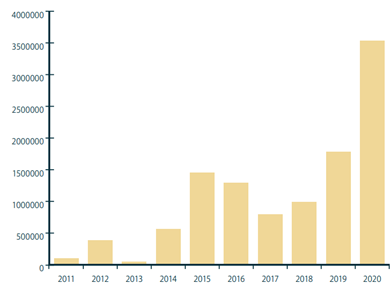
The Tyrolean government launched the “Climate-Smart Tyrolean Mountain Forests” project in 2019. A project which facilitates reforestation of climate-fit forests through awareness and capacity-building. One part of the project is the private sponsoring of a Climate-Smart Tyrolean Mountain tree Island, based on the principle of sustainable forest management. The “sponsor packages” comes in three variants, depending on the size of mixed forest islands. Through the professional set-up in 2020, 9,969 running metres of fence were erected and “mixed forest islands” were created. More than 5,900 plants were afforested (Klimafitter Bergwald Tirol).
Case of Wildermieming Protective Forest
In Wildermieming, the publicly owned protective forest is maintained by the dedicated forest supervisor. Over the past 25 years, the forest supervisor has been working on the transformation of the forest into a climate-fit forest, employing a forest management approach with the same basic principle as the Climate-Smart Mountain Forest.
Every Tyrolean municipality has a publicly funded forest supervisor who is responsible for managing the publicly owned forests and checks the compliance with regulations of privately owned areas (e.g. removing of damaged wood, safety of forest paths).
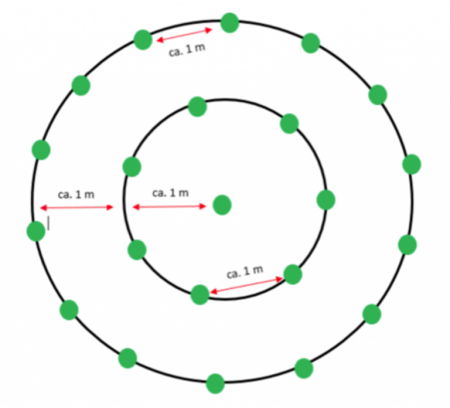
Layout of the Mixed-tree ‘islands’
Source: Klimafitter Bergwald Tirol
In one mixed forest ‘island’ 30 trees are planted. Out of these 30 trees – 1 is expected to be harvested as timber after 100 years. Meanwhile, the new tree species spread in the area through natural regeneration. Such a mixed forest island costs approx. 1.800 Euro depending on the site and size of the forest ‘island’.