

More than 80% of nature-based solutions (NbS) are funded by the public sector and historically, these solutions have often been delivered by the public sector too. More recently, we have seen communities become involved in the planning, delivery and stewardship of urban nature-based solutions. However, to a large extent the role of businesses and enterprises in urban greening has not been explored.
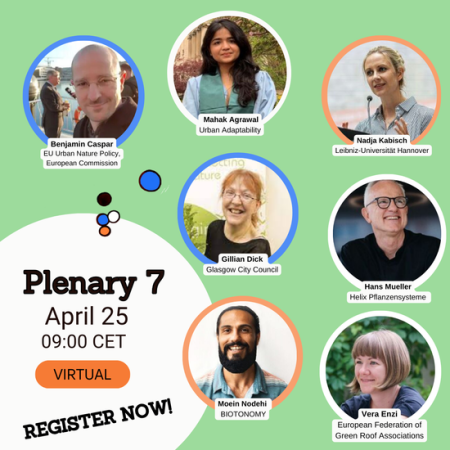
Aware of this knowledge gap, Invest4Nature is undertaking new research to explore the role of the private sector in delivering nature-based solutions. ‘Nature-based enterprises’ (NBEs) work across many sectors and domains delivering nature-based solutions, working with, and for nature. In the urban context, nature-based enterprises include many types of business from landscape architects and planners to green roof or wall companies. To raise awareness of the role of these enterprises in urban greening, on 25th April 2024, Horizon Nua chaired a panel discussion titled ‘Widening the tent: getting business and enterprise involved in urban greening’ as part of the global TNOC Festival.
Below we discuss some discussion highlights from the session. (Or scroll to the end of this page to read details on thepanelists!)
What is the role of city councils in stimulating business engagement in urban greening?
Gillian Dick, GCC “Our experience with nature-based entrepreneurship was through the launch of an NBE Accelerator Programme as part of the EU-funded Connecting Nature project. While entrepreneurship was not a natural fit with a planning department, nature was also not a natural fit with the entrepreneurship department. We came together to share our technical knowledge and along with other partners in university and social innovation, we ran two NBE Accelerator Programme with 30+ graduates. We didn’t know what to expect as this was the first time any city in the UK (or indeed Europe) had run anything like this. Both programmes were oversubscribed.”
What challenges do councils face in supporting new urban greening businesses?
Gillian Dick, GCC “Much as we wanted as a council to support our start-ups after graduation, the biggest challenge we found was that they were too small and early-stage to respond to tenders through our public procurement system.
We also found that communities weren’t involved that much with big business. While communities are more involved with small businesses like NBEs, we’re struggling with how to support them to keep them going. We’re looking towards other cities to see how they’re supporting small businesses from Bristol to Paris.
Another problem for the public sector is the perceived risks associated with bringing private financing into the public arena. The public sector, at least in Glasgow, tends to be more risk averse and afraid of a negative backlash in terms of green-washing.”
What does the public sector need to change to get more businesses involved in urban greening?
Hans Muller, Helix Pflanzensysteme: “We need to widen the focus towards the expected outcomes from urban greening in terms of ecosystem services. I don’t think the current public procurement processes are fit for purpose. Tenders need to put the emphasis on ecosystem service outputs.
Take for example, a public sector tender for apple trees. The tender should not just specify how many trees should be planted and how to plant them but more importantly, how many apples you want the tree to produce, when and for how long. This will then shift the emphasis in tenders towards how to get these outputs.
Current tender and procurement systems were designed to suit builders and engineers, not providers of nature-based solutions focused on ecosystem service outputs.
We are not monitoring outcomes from urban greening and I think we need to shift the emphasis to ecosystem service outcomes.”
How does the situation differ across Europe in terms of business involvement in urban greening?
Vera Enzi, European Federation of Green Roofs and Walls: “It is clear that there is a big difference across Europe in how the public sector is set up to support businesses and enterprises involved in urban greening. In Austria, the public sector is very much a first mover, a risk taker and an innovator.
We also need to recognise that market development is very different across Europe. In some countries, like Austria and Germany, the market for green roofs is well established and even industrialised. While we mightn’t have that many large enterprises in green roofs yet, we certainly have medium-sized, fast-growing businesses. In contrast, the green wall industry is still at an early dynamic growth stage in many parts of Europe. There is a lot to be learned from countries like Austria, on how the public sector can stimulate market development, new enterprise start-up and job creation. Grünstatgrau is Austria’s national centre of competence for green buildings and an innovation lab for greening cities. It stimulates market development, networks and connects suppliers with customers, supports research and development of innovative products and projects and leads on urban greening strategies.
What are the priorities for market development?
Vera Enzi, European Federation of Green Roofs and Walls: “A key question we need to ask is who can deliver biodiversity? Quality standards are very important. They help to attract investment and investors. There is a fear of green-washing across the public and private sectors. Standards help to de-risk investment. In Austria, we have developed the only standard for green walls in Europe. We start by asking what does the building need in terms of greening objectives – how can we increase biodiversity?
Another important priority for the future is shifting the focus towards green renovations of existing buildings. It is not easy and we have lots to learn but we have to shift the focus away from short-term construction builds.”
What can NBEs do themselves to grow their business?
Moein Nodehi, Founder & CEO of BIOTONOMY: “In order to get more businesses involved in urban greening, we need to show that businesses can make a good living out of urban greening. As the current ambassador of the green building community on the Connecting Nature Enterprise Platform (CNEP), I see that many start-ups in urban greening are highly vulnerable to changing market conditions. I think we need to get these nature-based enterprises to change their focus – they need to put less emphasis on ‘scientific speak’ and start thinking about why a company would invest in urban greening. If we look at an example from Malaga – we work in the tourism industry with hotels who want to rebrand to become more ‘green’. We help them to do this the right way. They might not start off asking for green building solutions because of the cooling benefits or benefits for health and wellbeing but once they have NbS in place they learn to appreciate and value these wider benefits. Then they start to invest in more and more NbS and spread the word among their peers. For us, it’s about changing perceptions – both for the urban greening NBEs and for the companies they are serving.
We need to communicate better and learn to speak the languages of business to understand what they want.”
Final words? What one thing would you like most to see change to encourage more businesses to get involved in urban greening?
Gillian: “Change the public sector funding model to focus on stewardship”
Hans: “Wisely unlock the creativity of entrepreneurs”
Moein: “I would like to see the public sector take more risks – there is an expectation that the private sector takes all the risks”
Vera: “I would like to see higher quality standards for biodiversity in all countries”
For more information on urban greening businesses or to join the community of nature-based businesses and enterprises active in this space, visit the Connecting Nature Enterprise Platform (CNEP)
Author’ Siobhán McQuaid, Horizon Nua
Website: https://www.horizonnua.eu/
Twitter:https://twitter.com/horizonnua
LinkedIn:https://www.linkedin.com/company/horizonnua/
Details on the panelists:
Gillian Dick, Manager of Spatial Planning in Glasgow City Council (GCC) in Scotland. In this discussion, Gillian shares insights on how planners in Glasgow stepped out of their comfort zone to launch an accelerator programme for nature-based start-ups.
Hans Muller, Founder and CEO of Helix Pflanzensysteme in Germany, is sometimes known as the ‘grandfather’ of green walls! Hans has been working since the 1980’s on delivering high quality vertical green infrastructure and his son is continuing the legacy today. Obsessed (in a good way) with long term maintenance of green infrastructure, he discusses the big changes he has seen in the industry over the past four decades.
Vera Enzi is the Vice-President of EFB, the European Federation of Green Roof Associations and is a founding member of Grunstatgrau, an innovation lab in Austria that brings together over 600 partner organisations all along the value chain of green buildings from planning to stewardship. Vera discusses how leadership from policy makers can stimulate market development
Moein Nodehi is founder & CEO of BIOTONOMY, based in Spain. After working on some of the largest construction projects in the world as an architectural engineer, Moein became disillusioned with the negative impact of conventional architecture on nature. This led to the creation of Biotonomy which uses nature as a solution for designing autonomous buildings. Moein shares insights in this discussion on the challenges facing nature-based enterprises.
Author: Siobhán McQuaid, Horizon Nua
Website: https://www.horizonnua.eu/
Twitter:https://twitter.com/horizonnua
LinkedIn:https://www.linkedin.com/company/horizonnua/
Image credits: Biotonomy (feature image) and The Nature of Cities Festival